Performance Exhaust Systems
Valved Exhaust Systems: Electronic and Vacuum Valves, and What Changes When They Open
The valve as a routing device: two paths, one system, and the test that decides whether it ships.
Published 2026-11-03
A valved exhaust is one system with two internal paths, and a valve that chooses between them. It is the most asked-about option in the catback range and the least well described in most catalogues, where the valve is treated as a feature bullet. The valve is a routing device inside the muffler, and three things follow from that: the two valve types, what opening the valve actually changes, and the bench test every valved system here passes before it is packed.
A note on expectations before the detail: a valve does not transform a system into a different system. The pipework, the muffler body and the tips are identical in both states; what changes is the route the gas takes through one section, and with it the sound level and character the driver hears. Buyers who understand the valve as a switch between two states of one well-made system specify it well. Buyers who expect it to be two exhausts in a trench coat are the ones who write disappointed reviews of competently made parts — a distinction worth drawing at the top of a post that intends to be useful.
- Workshop noteWritten from production practice
- Range-anchoredTied to a family in the range
- Process factsAs the work is done
- Fitment firstConfirmed on inquiry
Two Paths Through One Muffler
Inside a valved muffler section, the exhaust can travel two routes. The closed route passes through the full silencing layout: the longer path, the quieter state, the one the car starts in. The open route bypasses part of that layout, shortening the gas path through the muffler. The valve is the gate between them — a flap in the pipework, driven open or closed, nothing more mystical than that.
Everything outside the muffler is unchanged between the two states: same downpipe, same mid-pipe, same tips. That is why a valved system is specified as one system with two states rather than as two products, and why the comparison that matters at ordering time is not valved-versus-unvalved as a philosophy, but which valve type the application carries and how it is controlled.
Electronic Valves
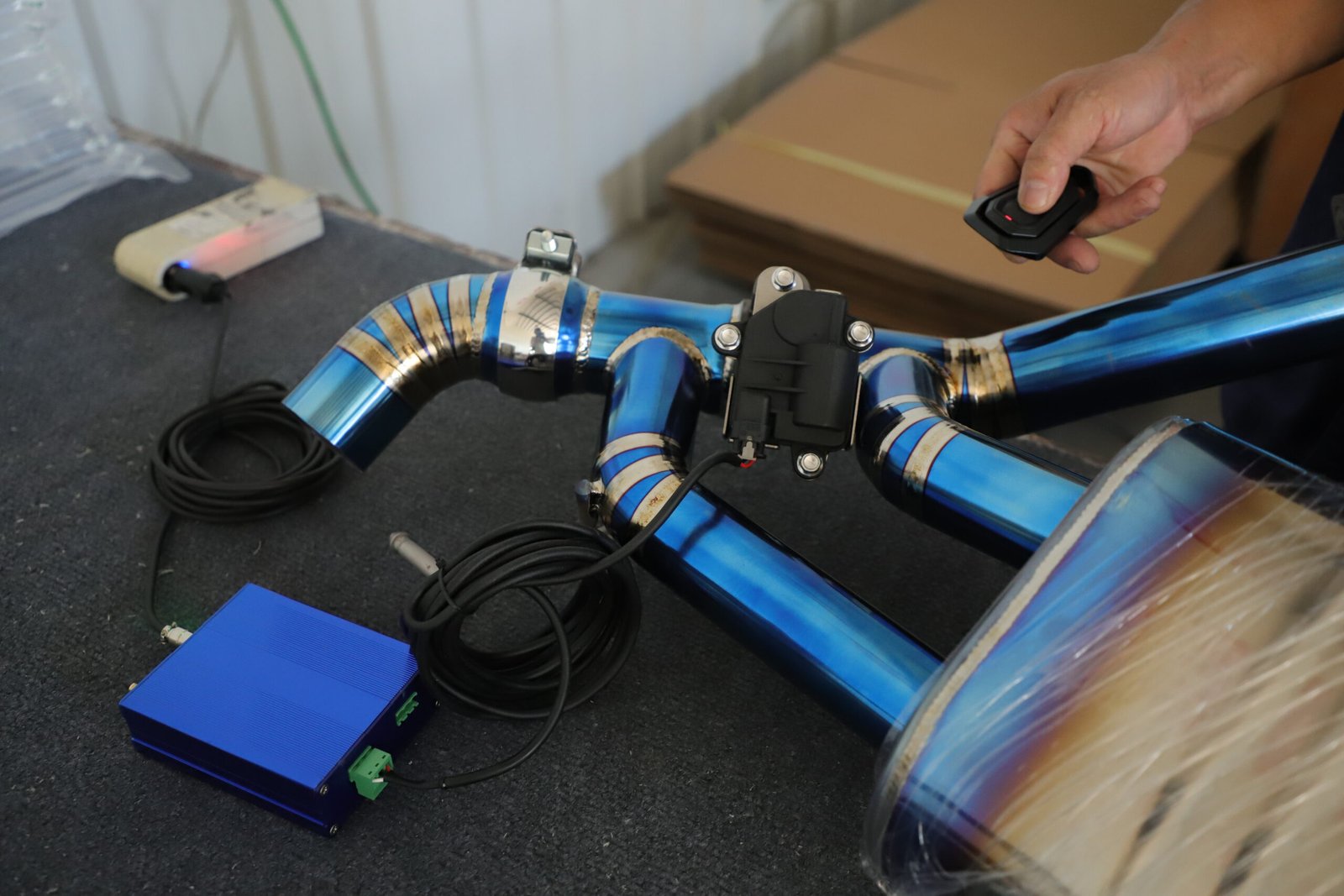
An electronic valve is driven by a motor mounted on the valve body. The control is a remote or a cabin switch; the power comes from the car's electrical system. Electronic actuation is self-contained — the system brings its own control hardware — which makes it the flexible option for applications whose factory layout did not include valve control.
In production, the electronic valve's motor, wiring and controller are part of the system as delivered. The installer connects power and mounts the control; the valve itself arrives installed, aligned and tested in the muffler section.
Vacuum Valves
A vacuum valve is driven by engine vacuum, through a control unit, in the arrangement many factory sport exhausts use. Where a car's factory system was vacuum-valved, the replacement valved system is usually specified to match, so the car's existing control logic drives the new valve the way it drove the old one.
The choice between the two types is therefore mostly an application fact, not a preference ranking: the valved systems page carries the table, and the quotation for a given car states its valve type plainly. Programs covering several cars should expect both types across the list.
The Bench Test, and Why It Is the Point
Before a valved system is packed, its valve is cycled on the bench: controller wired, remote in hand, the flap driven open and closed under observation. That test is photographed on a titanium section. The test checks the things that fail in the field when they are not checked in the factory — a flap that binds, a motor that stalls at the end of travel, a controller that does not answer its remote.
A valved system's valve is its only moving part and its most service-sensitive one, and it is the part the end customer will operate every day. Testing every system — not a sample of the batch — is the difference between a valved range and a returns queue, and it is why the test is described here rather than left as a line in a specification.
Specifying Valves Across a Range
Programs that carry valved systems across several cars meet both valve types and should expect to. The specification questions are per application: does this car have a factory valve arrangement to match, and if so, of which type? Does the program want a single control pattern across its range for its customers' sake, even where that means electronic valves on cars that could have taken vacuum? Neither answer is wrong; the error is not asking, and discovering at the third application that the range has drifted into two control patterns by accident.
The unvalved option belongs in the same conversation. Some applications in a valved range are better unvalved — cars whose buyers value simplicity, lines whose price position cannot carry the valve hardware honestly. A valved flagship and an unvalved volume line is a coherent assortment; a range that valves everything because the option exists is not making a decision, it is avoiding one.
What the workshop needs, per application, is short: the car and model year, the valve type if the program has a policy, the material, and the tip program. What it returns is equally definite: whether the application is produced valved, with which valve type, at what the system includes — valve, control and hardware, tested as a set. The valve is the part of the system the end customer will touch daily; the specification conversation is where the range decides whether that touch will feel deliberate.
For the avoidance of the most common disappointment: order the valve for the driving the car actually does. A valved system earns its hardware on cars that are driven in both states — the early-morning street and the open road, the quiet arrival and the deliberate one. A car that lives in one state is served as honestly by the unvalved version of the same system, at a simpler specification. The workshop builds both, prices both, and would rather sell the right one once than the wrong one twice.
That is the honest summary of the whole subject: a valve is a small machine for giving one exhaust two manners, and like any machine it rewards being chosen for the work it will actually do. Chosen that way — type matched to the car, control matched to the program, hardware tested as a set — it is the most satisfying option in the catalogue, because it is the one the driver operates, notices and judges every single day.
Source the parts behind valved exhaust systems
Send your vehicle, engine and item list for a confirmed fitment check and a quotation on the parts covered here.
Send an Inquiry