Performance Exhaust Systems
Headers vs Exhaust Manifold
Same job, two constructions: the cast manifold and the fabricated header, compared on construction and application.
Manifold and header are two words for the part that collects the exhaust from the cylinder head, and the difference between them is construction. A manifold is typically a casting: one compact piece that gathers the ports into a single outlet. A header is fabricated: individual tubes, one per port, routed and merged into a collector. In this range the two are one family — a single Manifold/Header category in the company's own catalogue — and the two are compared on the grounds a buyer actually chooses on.
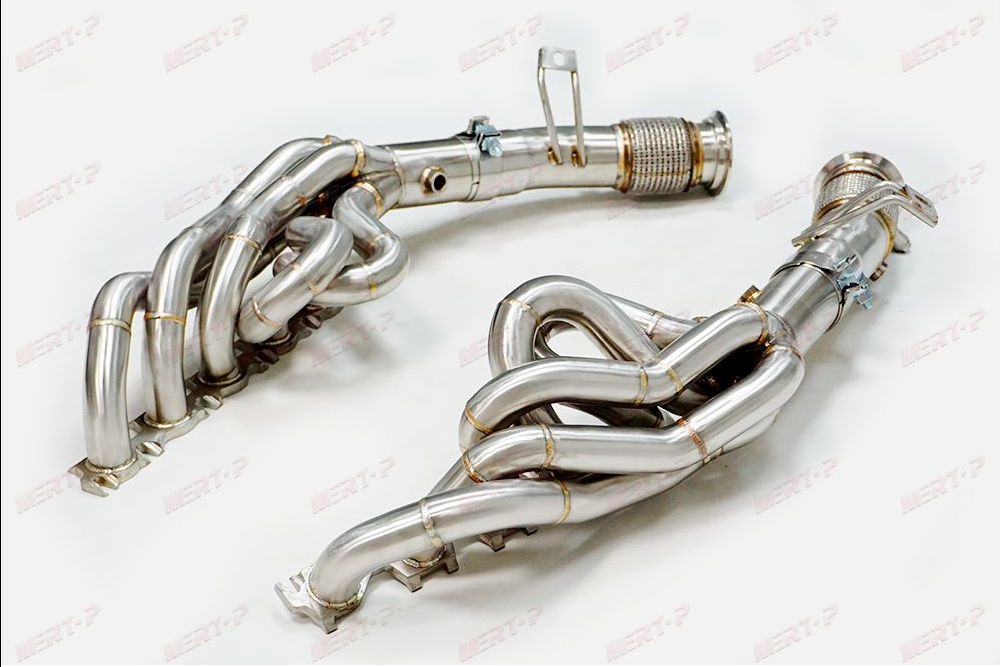
- Two constructionsCast vs fabricated tube
- One family hereBoth built in SS304
- Application decidesTurbo vs NA layout
- Shared flange ruleMachined to the head
The Comparison, Construction by Construction
The table sets the two formats side by side. The rows are construction and application facts: how each is made, what it does well, and which engines each serves in this range.
| Point | Exhaust manifold (cast / steam-pipe) | Header (fabricated tube) |
|---|---|---|
| Construction | Cast body or thick-wall steam pipe, compact routing | Individual bent tubes merged in a collector |
| Typical role | Carries the turbocharger on turbo engines | Scavenging layout for naturally aspirated engines |
| Runner lengths | Short and unequal by design | Long, with length a design variable |
| Flange | Machined flat after manufacture | Machined to the same head profile |
| In this range | Turbo manifolds for BMW, Audi/VW, JDM sixes | Long-tube headers, Audi 3.0 TFSI documented |
| Finishes | Ceramic coat, brushed, polished, shields | Ceramic coat, brushed, polished |
Which One an Engine Uses
The engine's aspiration usually decides before preference does. A turbo engine needs a manifold that positions and carries the turbocharger and feeds it from all cylinders in a compact space — that is manifold work, and in this range it is steam-pipe manifold work. A naturally aspirated engine has no turbo to carry, and the header's long individual tubes are the layout that suits it.
Supercharged and less common layouts sit between the two, which is why the documented long-tube example in the catalogue is the Audi 3.0 TFSI: a forced-induction engine whose factory layout made a fabricated header the right answer. The deciding document is always the application itself — send the engine, and the reply names the format in production for it.
What the Two Share in This Range
Everything downstream of the format choice is shared: SS304 as the material, flanges machined to the OEM port profile, development from the scanned original part, the same finishes and the same checks. A buyer does not choose between a well-made manifold and a well-made header here; the format follows the engine, and the making follows the format.
If you are speccing a program across both formats — turbo cars and NA cars in one range — one inquiry carries both lists, and the confirmation separates them by engine.
A last distinction is worth keeping clean, because catalogues blur it: shorty headers and factory-style manifolds occupy the same compact space at the head, and the long-tube header is a different commitment of engine-bay room. When a program says header, it should say which length it means. In this range the header line is the long-tube line, and anything compact is quoted as a manifold — the naming on the quotation follows the construction, so what a buyer approves is what the workshop builds.
Not Sure Which Variant Fits?
Send your vehicle and engine details and say which side of the headers and exhaust manifolds comparison you are leaning toward. Fitment is confirmed before quoting.
Send an Inquiry