Performance Exhaust Systems
Catted vs Catless Downpipe
One routing, two constructions: what is inside the pipe is the whole difference.
Catted and catless downpipes are the same part in two constructions. Both follow the same routing from the turbo flange to the mid-pipe joint, both are built on the same application fixture, and both carry the same flange faces and sensor positions. The difference is a single section of the pipe: the catted version houses a catalyst section in the run; the catless version runs straight through. The two are compared on construction and fitment — the grounds the workshop builds on — so a program can specify its variant on the parts themselves.
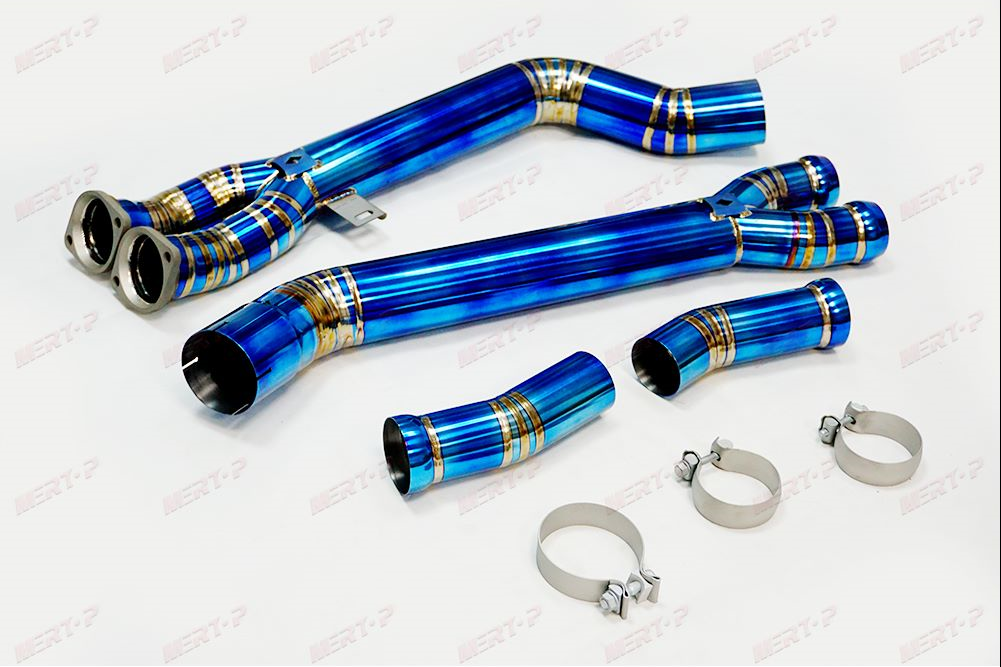
- Same routingBoth built on one fixture
- Catalyst sectionPresent or absent
- Same interfacesFlanges and bosses identical
- Construction onlyCompared on the parts
The Two Constructions Side by Side
Read the table as a parts list. Each row is a fact about what arrives in the crate for each variant. The catted crate carries a catalyst section in the run — a 200-cell high-flow section in the documented specification — where the catless crate carries plain pipe through the same space. Both are built on the same fixtures in SS304, with the same flange faces, sensor bosses and finish options, and heat shields are specified per application on either variant.
| Point | Catted downpipe | Catless downpipe |
|---|---|---|
| Pipe run | SS304 run with an integrated catalyst section | SS304 straight-through run, no catalyst section |
| Catalyst | 200-cell high-flow section, positioned as the factory section was | None — the section is open pipe |
| Routing | From the scanned original, on the application fixture | Identical routing, same fixture |
| Flanges & bosses | Machined flange faces; bosses from scanned positions | Identical faces and positions |
| Materials | SS304; titanium on listed applications | SS304; titanium on listed applications |
| Heat shields | Single and double layer where the application lists them | Same shield options |
| Sizes | 3-inch, 3.5-inch and 4-inch classes by application | Same size classes |
Fitment Is Not the Difference
Because both variants are built on one fixture, fitment does not separate them: if an application is in production as a downpipe, both constructions are specified against the same flange pattern, the same sensor positions and the same mid-pipe joint. A program can therefore carry both variants for one car — the same SKU family in two constructions — which is how most wholesalers in fact order them.
The applications are the family's: BMW B48, B58, N55, S55 and S63; Mercedes-AMG C43 and C63; MQB cars on EA888 and EA855; McLaren, Mini Cooper, Ford Mustang EcoBoost and Honda Civic 1.5T. Each variant is documented on its own engine — the B58 and the EA888.
How Buyers Usually Specify
Programs tend to decide variant policy at range level: one construction across the list, or both offered per car. The decision inputs are assortment inputs — what your customers ask for by name (catted and catless are both search terms buyers use), how your range is priced, and which construction your market's flagship applications take.
Whichever policy you set, the order mechanics are the same: specify application, variant, size class, material and finish per line, and the confirmation checks each line against its fixture before quoting.
One specification habit is worth adopting whichever variant a program leads with: keep the two constructions in step. A range that offers the catted version of a car in titanium and the catless version only in stainless, or the reverse, creates a comparison its own customers cannot complete. Because both constructions come off one fixture, holding materials, finishes and shield options parallel across the pair costs the program nothing in development — the parallelism is a listing decision, taken once, at range level.
Not Sure Which Variant Fits?
Send your vehicle and engine details and say which side of the catted and catless downpipes comparison you are leaning toward. Fitment is confirmed before quoting.
Send an Inquiry