Performance Exhaust Systems
Developing a Custom Exhaust From a Sample: Scan, CAD, Prototype, Fitment Check
The sample route, followed from the parcel arriving to the approved prototype.
Published 2026-11-03
The most common custom job in the workshop starts with a parcel: a sample exhaust part, sent by a buyer who wants a production source for it. That route runs in a fixed order — what to send, what the workshop does with it, what the customer approves, and where confidentiality sits — so a buyer planning a sample program can see the whole shape before committing a part to the post.
The sample route is one of three development routes — drawings or 3D data, and on-car development, are the others — and it is the most used because it asks the least of the customer: no engineering files, no vehicle, just the part itself and a clear statement of the program behind it. It is also the route with the fewest misunderstandings, because both sides are looking at the same physical object from the first day. What follows is that route, without the other two routes' branches.
- Workshop noteWritten from production practice
- Range-anchoredTied to a family in the range
- Process factsAs the work is done
- Fitment firstConfirmed on inquiry
What to Send, and What to Say With It
Send the part itself, complete if you can: a downpipe with its flanges and bosses teaches more than a downpipe cut for shipping. If the sample is a system, send the whole system; interfaces between sections are part of the specification. Photographs of the part installed help where clearances are tight, and the vehicle and engine it belongs to are essential information, not paperwork.
Say what the program is: the markets it serves, the finish and branding you want, and whether the replication is to be exact or a starting point. A sample sent for exact replication and a sample sent as a fitment donor for a redesigned part lead to different prototypes, and the difference is cheapest to state at the start. If the design is yours and exclusive, say so in the first message — the confidentiality cover goes in place before the sample moves.
Scanning and Measuring the Sample
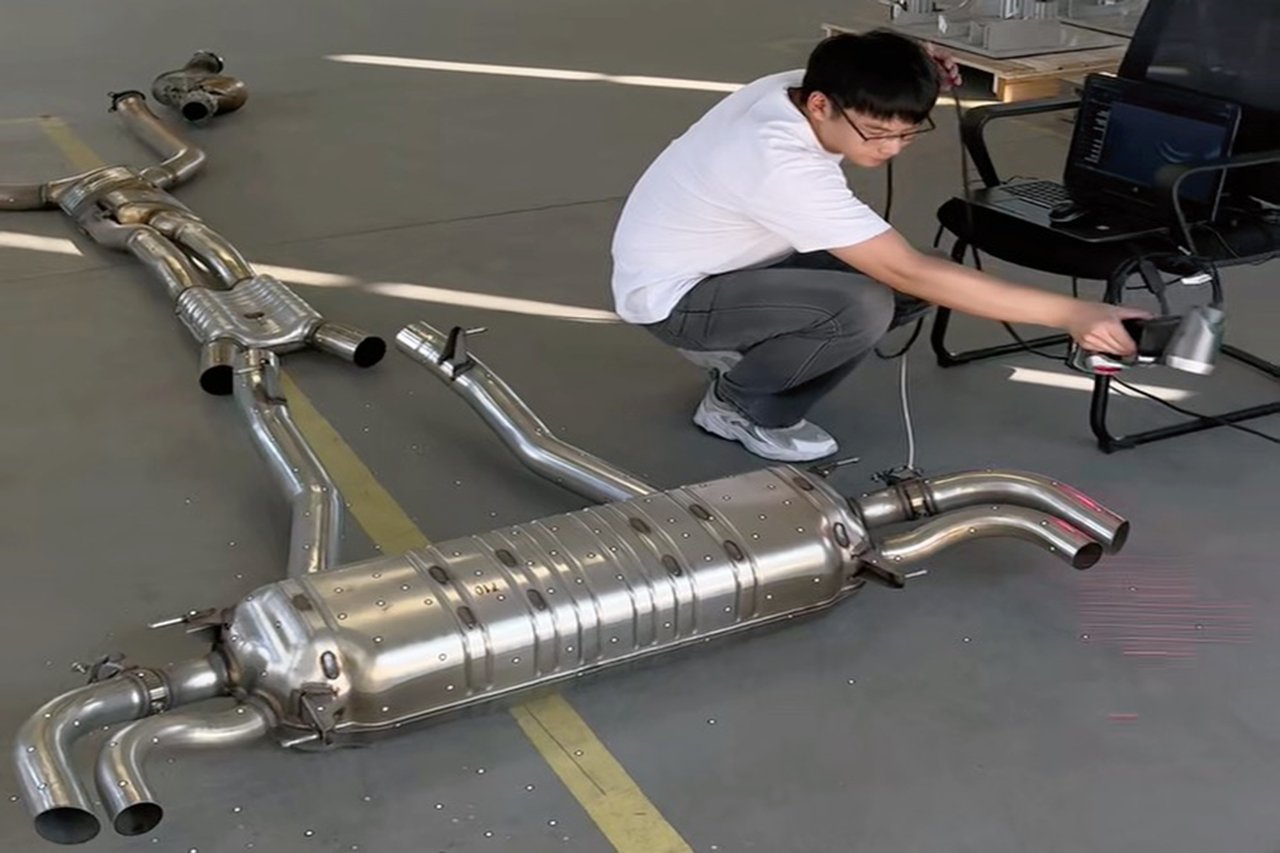
The sample is 3D scanned, and the scan is checked against hand measurement at the interfaces: flange faces, bolt patterns, boss positions, hanger locations. Scans are excellent at routing and shape; the interfaces are where production succeeds or fails, and they are verified with instruments.
The design is then built in CAD from the scan data. This is the stage where a replication becomes a production design: wall choices, bend radii the benders can repeat, weld access, and the fixture design are all settled here. The customer sees the outcome of this stage as the prototype; its quality is decided by how honestly the sample was read.
The Prototype and Its Checks
Fixtures are cut, and the prototype is bent, welded and finished on them. It then passes the production checks in full: dimensional inspection against the fixture and the scan data, weld testing, a smoke and leak test, and — where the vehicle is available — a fitment trial. Where the vehicle is not available, the sample itself is the fitment reference, and the prototype is compared interface by interface against it.
The prototype's record goes to the customer with the prototype or ahead of it: what was measured, what matches the sample, what differs and why. Differences are sometimes deliberate — a construction improved, a finish changed to the program's specification — and deliberate differences are declared in it rather than discovered.
Approval, Then Production
Production waits for approval. That sequencing is the route's main protection for both sides: the customer approves a physical part and its record, not a rendering, and the workshop produces to an approved reference rather than to a recollection of a conversation. Changes requested at approval re-enter at the design stage and produce a revised prototype; changes requested after production starts are new jobs, priced as such, which is why the approval stage deserves the customer's full attention. What is approved is more than the pipework. The branding the program specified — a logo engraved or laser etched at production, a custom tip design, the packaging the goods will ship in — is carried on the sample itself, so approval covers the finished article the end customer will unbox, not a drawing of it. A trial sample also serves as the fitment and quality reference for the first bulk run: production parts are checked against it, which is why the sample is built by the production process and not by a prototype shortcut.
From approval, the job becomes ordinary production: the same fixtures, the same checks, the branding and packaging the program specified. The sample route's whole argument is that ordinariness — a custom part that, once approved, is no longer custom at all, just a catalogue of one customer's.
When the Sample Route Is the Wrong Route
The route has limits, and naming them saves both sides a parcel. A sample cannot teach clearances it never met: if the part's difficulty is the space around it rather than the part itself, on-car development reads the problem better. A worn or damaged sample teaches its wear as faithfully as its design — a bent hanger scans as a bent hanger — so samples should be the best example available, and known damage should be declared with it, so the design stage can separate the part's intentions from its history.
Rights are the other limit. A sample is replicated as the customer's program requires, and the customer is responsible for the design being theirs to reproduce — a factory part, a part of their own design, or a part they are licensed to make. Where that is not clear, the conversation happens before the scanning does. The workshop's confidentiality runs in both directions: customer designs are held as confidential, and the same respect is expected for other customers' designs that a sample might represent.
Within those limits, the route is as close to foolproof as manufacturing gets: the evidence is physical, the prototype is comparable to it point by point, and approval is a judgement the customer can make with the two parts side by side on a bench. Most sample programs that fail, fail before the parcel — in an unclear brief — which is the cheapest place for a failure to occur, and why the sending deserves this much care.
The brief itself can be short. It needs the application, the program behind the part, the finish and branding intent, the rights position, and any damage or modification the sample carries. Five sentences, honestly written, will do more for the finished part than any tolerance table attached to a vague one — because the route's machinery, the scanning and fixturing and checking, is only ever as accurate as the statement of what it is being accurate about.
Source the parts behind sample-based development
Send your vehicle, engine and item list for a confirmed fitment check and a quotation on the parts covered here.
Send an Inquiry